Puns from Act 1 of Romeo and Juliet are everywhere once you know what to look for. The opening act moves from a street fight to a party invitation, Juliet’s marriage discussion, the masked journey to the Capulet feast, and Romeo and Juliet’s first meeting.
Shakespeare plays with words such as move, stand, collier, choler, sole, soul, sore, soar, bound, and lie. Act 1 also gives Mercutio plenty of room for playful language, especially during the Queen Mab speech.
The collection below uses those scenes, characters, themes, and wordplay as inspiration. The lines are original jokes and modern puns rather than quotations from the play, so they work for classroom humor, study notes, captions, Shakespeare posts, and casual laughs.
Table of Contents
Puns from Act 1 of Romeo and Juliet 🎭
Act 1 is a play on words before it is a play of swords.
Verona’s feud is really a pointed disagreement.
Romeo’s love life is already in a state of re-verse.
Every argument in Verona comes with a sharp point.
The Capulets and Montagues have a very cutting relationship.
Peace in Verona is apparently out of stock.
The family feud keeps taking things a little too literally.
Act 1 puts the “fight” in wordfight.
Romeo is miserable, but his metaphors are thriving.
His heart is heavy, yet his language stays light.
The party invitation is a plot-twist with good stationery.
One guest list, and fate gets well-listed.
A mask can hide a face, not a pun.
Romeo goes to a feast and leaves with a piece of the plot.
Benvolio wants to change Romeo’s mind, not just his mood.
Mercutio changes the mood by changing the meaning.
Shakespeare gives ordinary words extra dramatic mileage.
Verona has a serious case of family business, literally.
The feud has become a matter of blood and branding.
Love enters the story disguised as another guest.
Juliet is the plot’s newest heart-stopping attraction.
Tybalt hears Romeo and instantly gets voice-activated anger.
Capulet wants peace, but Tybalt wants a piece of Romeo.
The banquet serves food, masks, and unexpected feelings.
Act 1 has enough romance to make the feud feel awkward.
Romeo’s Rosaline era is a rose with too many thorns.
The second crush arrives with much better timing for the plot.
Every scene adds another pun-der to the stack.
The dialogue crosses lines before the swords draw them.
By the finale, love and family are officially at odds.
Act 1 Scene 1 Puns ⚔️
The opening fight has serious street-fair energy.
Montague and Capulet servants really know how to start a beef.
Beef is on the menu, and peace is not.
Their feud has become a full-time occupation.
Everyone is ready to draw conclusions and swords.
One argument, two families, zero peaceful resolutions.
The servants are fencing with words before fencing with blades.
That is what I call an edgy conversation.
Their dialogue has more points than a debate club.
Verona’s peacekeeping strategy is basically damage control with swords.
Prince Escalus arrives with a royal cease-and-desist.
His warning is the least optional invitation in town.
The fight gets postponed, but the tension stays on schedule.
Nobody wants to carry coals, but everyone carries a grudge.
Coal becomes the scene’s hottest wordplay fuel.
Collier and choler turn anger into a coal mine of jokes.
That argument is fueled by choler and a little coal.
To strike is easy; to strike a pose is apparently harder.
Move the body, move the argument, move the plot.
Being moved in Verona can mean anger, action, or both.
Stand your ground, because the grammar may move beneath you.
The wall becomes the original social media boundary.
Take the wall, take the space, take the pun.
The weakest goes to the wall, so the wall stays winning.
A collar becomes an escape plan with neck-level wordplay.
Drawing a sword and drawing attention happen at once.
The servants can draw steel and a laugh.
Montague becomes the name everyone is strangely motivated to mention.
Capulet comes with family pride and a capital attitude.
Even the dogs get drafted into the wordplay.
Verona’s sidewalks are doing overtime as neutral territory.
The opening brawl is basically a conflict-management fail.
The Prince has to put a period on their sentence.
Nobody in Scene 1 knows how to stop at a comma.
Romeo arrives after the fight with a whole different kind of ache.
The first scene proves a feud can be both hostile and hilarious.
Romeo’s Lovesick Wordplay ❤️
Romeo is out of love and out of luck.
His heart is heavy, but his wordplay has lift.
Love has Romeo seeing life through tragic-lens glasses.
His mood is so low, even the metaphors need stairs.
Romeo’s crush has turned him into a full-time sigh professional.
He has enough heartbreak to fill a sonnet subscription.
Romeo is feeling blue without even needing a color pun.
His love life is a case of heart before logic.
Benvolio says “move on”; Romeo takes the word personally.
Romeo would rather multiply his metaphors than divide his grief.
His sadness keeps adding layers and subtracting sleep.
Romeo’s feelings are in a serious state of re-flux.
Every sigh comes with complimentary dramatic irony.
His heart is in debt, and the interest is poetic.
Romeo has a crush with excellent terms and terrible conditions.
Rosaline is his favorite subject, but she will not enroll.
His eyes are loyal, even when his plans are not.
Romeo’s love is blind, but his metaphors have 20/20 vision.
He is emotionally unavailable to happiness.
Benvolio tries a new viewpoint; Romeo keeps the old angle.
Romeo’s heartbreak is practically a literary major.
He turns one rejection into a whole verse department.
His feelings are complicated enough to need a footnote.
Romeo is the only man in Verona making misery sound elegant.
His emotional baggage is already carry-on sized and overpacked.
One crush has him writing the deluxe edition of sadness.
Romeo’s mood swings are powered by poetic fuel.
He keeps falling for love and rising for rhetoric.
The word “fair” gets unfairly overworked around Romeo.
His romance is stalled, but the language keeps speeding.
Act 1 Scene 2 Puns 📜
Capulet’s guest list is a list of plot-portunities.
Paris brings a suit, and Capulet gives him a long review.
That proposal is still waiting for parental approval.
Paris is ready to pair, but Capulet wants to prepare.
The marriage talk has plenty of courtship, little commitment.
Capulet treats romance like an application under consideration.
Juliet’s future is being discussed like a calendar invite.
Paris has a proposal; Capulet has a postponement.
That is one suit that cannot be settled in court.
The feast invitation is a formal open-door policy.
The servant can read names only after asking for help.
His literacy issue becomes Romeo’s destiny issue.
The guest list is where the plot starts getting address-ed.
Romeo sees Rosaline’s name and suddenly RSVP means “Romeo, Say Please.”
Benvolio turns party plans into a comparison experiment.
Romeo calls it a feast; fate calls it a setup.
The invitation is free, but the consequences are not.
One party pass comes with a lifetime of plot development.
Rosaline gets Romeo to the party, then exits the romance spotlight.
The guest list is basically destiny in alphabetical order.
Capulet’s house is open for guests and closed for peace.
The feast is a very fancy plot device.
Romeo reads the names and gets a future spoiler.
The servant’s confusion is a page-turning problem.
Reading the list is easy; reading fate is not.
Romeo can decode the names but not the warning signs.
Capulet hosts a party that deserves a plot insurance policy.
Scene 2 proves a guest list can be a literary cliffhanger.
Act 1 Scene 3 Puns 🌹
Juliet gets a marriage pitch before she gets a party pitch.
Paris is presented like a husband with excellent packaging.
Capulet’s approval process has more steps than a staircase.
Juliet is asked to meet a match, not make a match.
Paris brings romance; Juliet brings a careful review.
Her answer is basically “I’ll consider the terms.”
Marriage enters the room with formal shoes on.
Juliet’s love life starts with a committee meeting.
Paris is available, but Juliet is not automatically sold.
Lady Capulet makes courtship sound like a product launch.
Juliet says she will look, which is a very literal first look.
The proposal is in preview mode.
Her feelings are still buffering.
Juliet keeps her options open while keeping her heart closed.
The Nurse brings old memories and new matchmaking energy.
Childhood stories make the conversation unusually well-nursed.
The Nurse has enough history to turn small talk into archive talk.
Juliet hears “Paris” but does not book the trip.
That marriage idea needs more than a good itinerary.
Capulet family romance comes with terms, conditions, and relatives.
Juliet is asked to inspect a match before accepting the match.
The scene is all about choice before the choice gets a chance.
Paris may be polished, but Juliet wants to polish the decision.
Her first romantic assignment is basically “research before purchase.”
Juliet leaves with a question mark where a wedding ring might be.
Act 1 Scene 4 Mercutio Puns ✨
Mercutio enters and instantly puts the “wit” in witty.
Romeo brings a torch; Mercutio brings the torch-level teasing.
Romeo feels heavy, so Mercutio turns light into a punchline.
His dancing shoes have sole authority.
Romeo’s soul is heavy enough to need a shoehorn.
That shoe joke has serious sole potential.
Romeo is sore about love, then starts talking about soaring.
Sore and soar are practically the same pun with different altitude.
Mercutio gives Romeo a verbal lift.
Romeo feels bound, but the jokes keep bouncing.
The conversation keeps dancing even when Romeo will not.
Mercutio can turn footwear into philosophy.
Those nimble soles are carrying a very heavy soul.
Romeo’s leaden mood has entered the shoe department.
A torch is lighter than Romeo’s emotional baggage.
The mask is on, but the wordplay is showing.
Mercutio treats every phrase like a verbal costume.
Dreaming becomes doubly useful when you can lie down or lie.
That dream can tell the truth while the dreamer tells a lie.
Mercutio makes sleep sound suspiciously literary.
Queen Mab arrives with a royal pun portfolio.
Her tiny crown comes with giant comic mileage.
Mercutio turns one fairy into a whole dream economy.
Queen Mab is small enough to be whimsical and grand enough to reign.
Dream logic gets a promotion to pun logic.
Mercutio’s imagination is always on fairy duty.
His Queen Mab detour has more layers than a bedtime story.
Romeo says dream; Mercutio says “let me expand that.”
The speech floats from dream to joke without losing its footing.
Mercutio is basically a walking pun generator in velvet shoes.
Romeo wants a quick answer; Mercutio gives deluxe commentary.
His wordplay has excellent timing and questionable restraint.
The conversation is so witty, even silence would feel underdressed.
Mercutio can make a mask feel transparent.
Romeo’s worries are real, but Mercutio makes them pun-able.
Light, lead, sole, soul, sore, soar: Romeo brings a whole word family.
The scene proves that a heavy mood can still have light-footed language.
Queen Mab is the only guest who arrives without an RSVP.
Mercutio’s dream talk turns bedtime into a comedy stage.
Act 1 Scene 4 has more verbal motion than Romeo’s shoes.
Act 1 Scene 5 Puns 💫
Capulet’s feast is a banquet of plot devices.
Romeo enters masked and leaves emotionally unmasked.
The party is disguised, but the chemistry is not.
Tybalt hears Romeo’s voice and gets instantly pitch-black.
Capulet tells Tybalt to keep the peace, not the piece.
Tybalt wants Romeo removed; Capulet wants the mood preserved.
The family feud crashes the dress code.
Romeo’s voice becomes his anti-disguise.
The mask covers his face but cannot cover his crush.
Juliet becomes the night’s most memorable guest.
Romeo sees Juliet and gets a new favorite view.
Their first meeting is a meet-cute with a family feud.
Two star-crossed surnames make one very complicated introduction.
Romeo and Juliet trade lines like a literary tennis match.
Their wordplay turns flirting into formal verse.
Romeo’s heart finds its Juliet-ine way into the conversation.
Juliet gives him a response that lands right on rhyme.
Their first exchange is basically a sonnet with chemistry.
Romeo finds a new meaning for “fair” in one glance.
Juliet is a jewel in the banquet’s crown.
That kiss is officially an action with a reaction.
Juliet says he kisses by the book; Romeo follows the sequel.
Their kiss has a well-read twist.
The Nurse interrupts with perfect comic timing.
Romance gets a surname reveal and suddenly becomes surname-ware.
Romeo’s crush is a Capulet, so his heart picked the wrong house.
Juliet’s admirer is a Montague, so her heart picked the rival aisle.
The love story gets a family-label problem.
Two names become the biggest obstacles in the room.
Romeo’s “account” suddenly comes with emotional debt.
Juliet’s family tree has just become Romeo’s stress tree.
The party ends with feelings up and family approval down.
Tybalt wants a fight; Romeo wants a Juliet.
Capulet keeps the banquet civil, but the romance is anything but.
Montague vs. Capulet Puns 🏰
Montague and Capulet are stuck in a surname stand-off.
Their family feud has a long history and a short fuse.
Every family dinner comes with a side of rivalry.
The feud is inherited, like a very bad family heirloom.
Peace would be novel in both the literal and literary sense.
Their relatives keep turning family ties into family fights.
Montague brings one house; Capulet brings another headache.
The two names are practically competing brands.
Verona’s biggest rivalry has excellent name recognition.
The feud is famous, but nobody ordered it.
Capulet wants his house full of guests, not arguments.
Montague would probably prefer a quieter invitation list.
The party is a house call with a plot problem.
Every surname in Act 1 comes with baggage.
The family tree is growing, but the branches are fighting.
Romeo and Juliet are caught in a cross-surname situation.
Their romance has a built-in family fine print.
Love ignores the surname field.
The feud checks last names before allowing happiness.
That is one relationship status stuck on “it’s complicated.”
Montague and Capulet need less territorial thinking and more territory sharing.
Verona has a family feud with excellent dramatic branding.
The houses are divided, but the feelings are not.
Two households, one city, unlimited awkward encounters.
The feud has more history than chill.
Every family member seems professionally committed to being annoyed.
The surnames keep getting in the way of first names.
Romeo is looking for a date; the feud is looking for a debate.
Juliet gets a Romeo, but not the correct family label.
Act 1 proves that a family name can carry serious plot weight.
Shakespeare Study and Classroom Puns 📚
Studying Act 1 is a real scene-ario worth exploring.
Romeo and Juliet homework can be tragic but still punny.
Your Shakespeare notes deserve a little dramatic irony.
Act 1 has enough wordplay to keep the margins busy.
The best study buddy is one who can spot a double meaning.
Romeo’s heartbreak is basically an advanced literature topic.
Mercutio deserves extra credit for extra wordplay.
Queen Mab could teach a masterclass in dream logic.
Scene 1 is basically “fight first, grammar later.”
Capulet’s guest list is a plot map in disguise.
The servant’s reading problem becomes the class’s favorite turning point.
Juliet’s marriage talk is a lesson in measured decisions.
Tybalt’s temper is a case of immediate over-reaction.
Romeo’s mood is a textbook example of emotional over-writing.
His metaphors have more weight than his actual schedule.
Benvolio’s advice is practical; Romeo’s response is poetic.
That is what happens when a thesis gets lovesick.
Mercutio can make a glossary feel entertaining.
Every pun is a little footnote with attitude.
The play keeps proving that context is everything.
A good pun can have two meanings and one laugh.
Act 1 rewards readers who look between the lines.
Shakespeare makes vocabulary do double duty.
One word can become two jokes with the right context.
The feud is a theme; the wordplay is the seasoning.
Class discussion gets lively when the language gets slippery.
Students can study the scene and still enjoy the scene.
Romeo’s oxymorons are basically contradiction with a degree.
Mercutio’s banter earns a gold star in verbal agility.
Act 1 is proof that old language can still be playful.
Instagram and Short Caption Puns 📸
Serving serious Verona vibes.
Feeling starry-eyed, slightly sword-shy.
Plotting my next plot twist.
Masquerade mood, Romeo edition.
Too glam to feud.
Current status: happily dramatic.
Keeping it fair and very unfairly cute.
Found my Juliet, lost the chill.
Serving love with a side of lineage.
Feud less, flirt more.
Romeo-ncing my way through the day.
Juliet-ly speaking, this look works.
Montague mood, Capulet confidence.
Masked, but the feelings are showing.
Plot twist: I came for the party.
Too witty to sit quietly.
Sole-fully committed to the vibe.
Soaring despite a sore heart.
Dreaming with a little Queen Mab energy.
Royal dream mode activated.
Putting the wit in Shakespeare.
Today is giving tragic-comic energy.
Name the feud, keep the romance.
Proof that bookish can be flirtatious.
Ending the day on a sonnet.
Quick Act 1 Q&A Jokes 😂
Why did Romeo carry a torch? He needed light for his heavy feelings.
Why did Mercutio love shoes? He had a strong sole for wordplay.
Why did Romeo miss the dance? His soul had no sole support.
Why did Romeo feel sore? Love kept making him soar emotionally.
Why did Mercutio like dreams? Every sleep had another lie waiting.
Why did Queen Mab get promoted? She already knew how to reign over dreams.
Why did Tybalt hate surprise guests? He had a short fuse and a longer feud.
Why did the servant study the guest list? He needed help reading the plot.
Why did Juliet stay undecided? She wanted to inspect the match before making a match.
Why did the banquet feel nervous? The guest list had too much plot pressure.
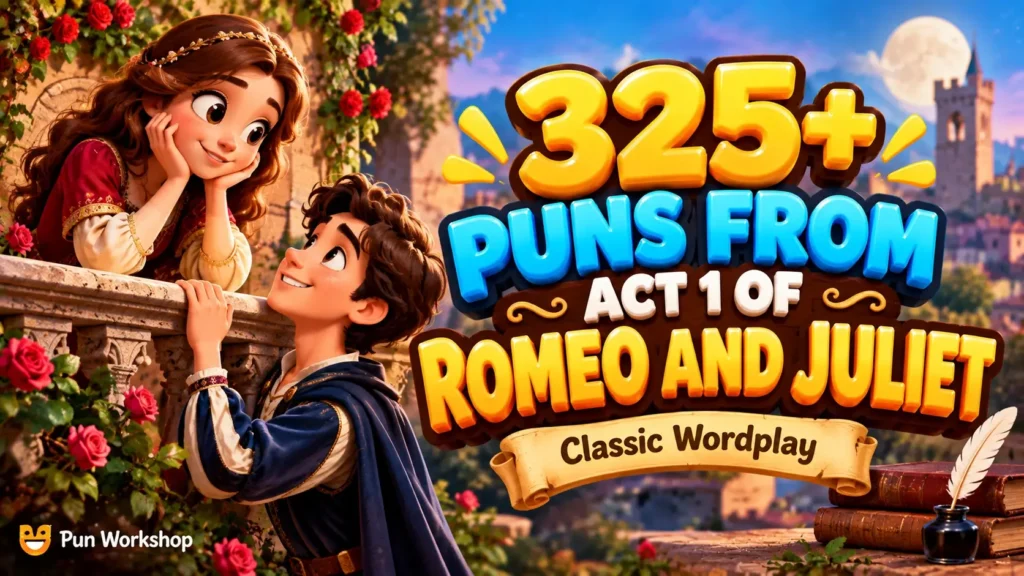
A vibrant featured image for 325+ puns from Act 1 of Romeo and Juliet, featuring Romeo, Juliet, roses, and bold 3D typography.
Frequently Asked Questions
Some of the clearest wordplay involves collier and choler, move, stand, wall, sole and soul, sore and soar, and the double meaning of lie. Mercutio’s Queen Mab speech also contains layered wordplay.
Mercutio is especially playful with language in Act 1, Scene 4. Romeo also uses repeated wordplay, particularly when describing his sadness and when talking with Mercutio on the way to the Capulet party.
The sole/soul exchange is one of the most recognizable examples. Romeo contrasts dancing shoes with his heavy soul, creating wordplay through two words that sound alike but have different meanings.
Yes. They can help students understand Shakespeare’s wordplay, character voice, tone, and double meanings. They can also work as discussion starters when explaining how humor and tension appear together in the opening act.
Yes. Romeo uses several contradictory combinations when describing love and sadness, while other characters rely on direct wordplay and double meanings. These different devices help show how differently characters experience the same events.
Useful related topics include Romeo and Juliet puns, Shakespeare puns, Mercutio jokes, Juliet puns, Shakespeare captions, and literary puns for students.
Conclusion
These 320+ puns from Act 1 of Romeo and Juliet turn Shakespeare’s street fights, love-sick speeches, masked party, family feud, and famous wordplay into quick modern jokes.
Use the shorter lines for captions, the classroom jokes for study breaks, and the character-based puns when you want to show how Romeo, Juliet, Mercutio, Tybalt, and the Capulet-Montague feud can inspire playful language.
Act 1 may begin with a fight, but Shakespeare makes sure the words get plenty of action too.